In a Database Management System (DBMS), concurrency control is a mechanism in DBMS that allows simultaneous transactions update while maintaining ACID Properties - Atomicity, Consistency, Isolation, and Durability.
In this blog, we will explore the concept of Transaction Concurrency Control in database systems, its importance, and the various techniques used to manage concurrent transactions effectively.

Table of contents
Open Table of contents
ACID Properties
Basic concepts:
Transactions are the operations that allow to modify and retrieve data from database. However, to ensure that the data is correct, reliable and consistent, DBMS must guarantee ACID Properties for all transactions.
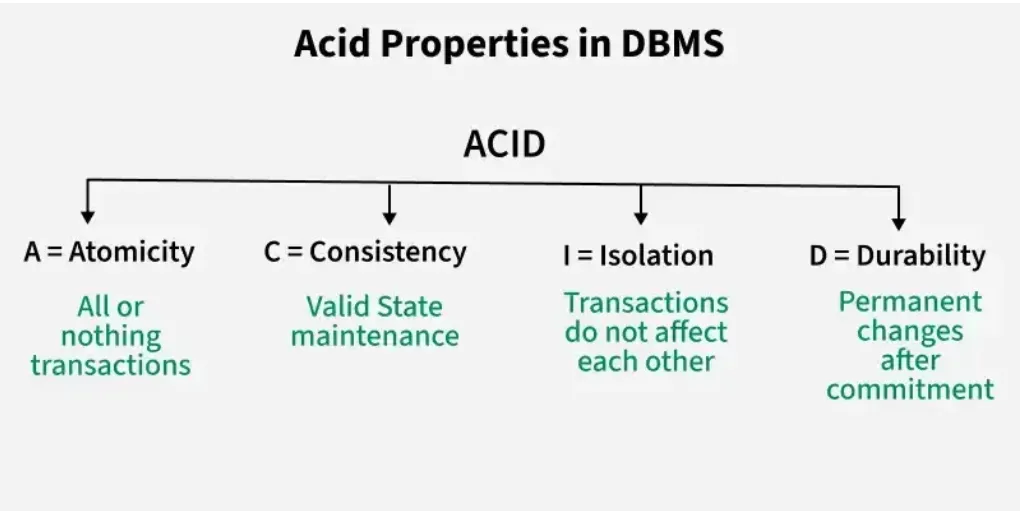
1. Atomicity
Atomicity means a transaction is all-or-nothing either all its operations are succeed or none of them are applied. If any part fails, the entire transaction is rolled back to keep database consistent.
- Commit: If the transaction is successful, the changes are permanently applied to the database.
- Abort/Rollback: If the transaction fails, any changes made during the transaction are discarded.
2. Consistency
- Consistency ensures that database remains in a valid state before and after the transaction. A valid state must follow all defined rules, relaionships.
- If a transaction violates any of the rules, it will be rolled back to maintain consistency.
3. Isolation
- Isolation ensures that transactions run independently without interference from other concurrent transactions.
- It ensures that the result of concurrent transactions is the same as if they were run after another.
4. Durability
Durability ensures that once the transaction is commited, data is permanently stored in the database and will not be lost even in case of system crash.
Responsibility for maintaining ACID properties:
| Property | Responsibility |
|---|---|
| Atomicity | Transaction Manager |
| Consistency | Application Programmer |
| Isolation | Concurrency Control Manager |
| Durability | Recovery Manager |
Concurrency Control Protocols
** These are set of rules correctness and consistent of transaction. The 2 main protocols are:**
1. Lock-Based Protocols Control
Types of Lock
-
Shared Lock (S): Shared Lock is also known as Read-only lock. As the name suggests, it can be shared between transactions because while holding this lock, the transaction does not have the permission to update data on the data item. S-lock is requested using
lock-Sinstruction. -
Exclusive Lock (X): Data item can be both read as well as written. This is exclusive and cannot be held simultaneously with any other lock on the same data item. X-lock is requested using
lock-Xinstruction.
Types of Lock-Based Protocols
1. Simplistic Lock Protocol
The simplest locking approach: a transaction must acquire a lock on the data item before any write operation (insert, update, delete), and releases the lock when the transaction finishes.
Example: Data item X = 10
T1acquires an X-lock onX, updatesX = 20, then releases the lock.T2requests an S-lock onXbut must wait untilT1releases its lock.T2reads the updated valueX = 20.
⚠️ This protocol handles basic concurrency but cannot prevent deadlocks and limits concurrency.
2. Pre-Claiming Lock Protocol
To avoid deadlocks, a transaction must declare and acquire all locks it needs before it starts. It only runs if every lock is granted; otherwise, it waits (or rolls back).
Example: Data items X, Y
T1pre-claims: X-lock onX+ S-lock onY. Both are available → granted,T1runs.T2requests an S-lock onX, but it is locked byT1→T2must wait.- When
T1finishes and releases its locks,T2gets the lock and proceeds.
⚠️ Deadlock-free, but inefficient when there are many transactions competing for locks.
3. Two-Phase Locking (2PL)
A transaction follows 2PL if locking and unlocking are done in two distinct phases:
- Growing Phase: transaction may acquire new locks, but cannot release any.
- Shrinking Phase: transaction may release locks, but cannot acquire new ones.
⚠️ 2PL guarantees serializability but can still suffer from deadlocks and cascading rollbacks.
4. Strict Two-Phase Locking (Strict 2PL)
A stricter variant of 2PL: all Exclusive (X) locks are held until the transaction commits or aborts — they cannot be released during the shrinking phase like in basic 2PL.
✅ By holding X-locks until commit, no other transaction can read uncommitted data → avoids cascading rollbacks.
5. Rigorous Two-Phase Locking (Rigorous 2PL)
An even stricter variant of Strict 2PL: all locks — both Shared (S) and Exclusive (X) — are held until the transaction commits or aborts.
💡 Simplest to implement and easiest for deadlock prevention ordering; the trade-off is lower concurrency since locks are held longer.
Deadlock Comparison
| Protocol | Serializability | Can Deadlock? |
|---|---|---|
| Basic 2PL | ✅ | Yes |
| Strict 2PL | ✅ | Yes (even more likely — locks are held longer) |
| Rigorous 2PL | ✅ | Yes (most likely) |
| Pre-Claiming | ✅ | Never |
Why is Pre-Claiming deadlock-free?
2PL — deadlock by circular wait:
    T1 ══════ holds ═════▶ [X]
     ▲                      ┆
     ┆                    waits
   waits                    ┆
     ┆                      ▼
    [Y] ◀═════ holds ═════ T2
T1 and T2 hold one item each and wait for each other’s lock → cycle → stuck forever.
Pre-Claiming — never “hold + wait”:
T1 needs {X, Y} → some lock unavailable? → take NOTHING, just wait
                                           (no locks held = no cycle)
The trade-off:
- Must know all data items needed in advance (usually impractical).
- Lower concurrency — transactions wait even if only one lock is unavailable.
💡 In practice, DBMSs prefer Strict 2PL + deadlock detection (wait-for graph) or timestamp ordering over Pre-Claiming.